Only a look at the surface


Surface technology: The underestimated key technology of industrial value creation
In the public perception, surfaces are often reduced to "finish" – to appearance, colour or corrosion protection. In reality, they determine friction, wear, service life, electrical conductivity, biocompatibility or temperature resistance. They are therefore functional system components.
Especially in the mobility industry – from electric drives to fuel cells to autonomous sensor platforms – surface technology is not an add-on, but a performance enabler. Anyone who underestimates them is wasting efficiency, durability and differentiation potential.
Scientific Classification of Surface Processes
In materials science, surface processes are systematically classified – primarily according to the principle of action and depth of intervention. Among other things, the classification according to DIN 8580 (manufacturing processes) as well as thermodynamic and physicochemical mechanisms is decisive.
1. Mechanical processes
Principle: Removal or plastic deformation of the edge zone
Examples: Grinding, polishing, blasting, shot blasting
Objective: Roughness, residual compressive stresses, fatigue resistance
2. Thermochemical surface layer treatment
Principle: Diffusion of atoms into the edge zone at elevated temperature
Examples: Nitriding, case hardening, carbonitriding
Objective: Hardness, wear resistance, fatigue resistance
3. Chemical and electrochemical processes
Principle: Deposition by chemical reaction or electrolytic processes
Examples: electroplating, electroless nickel (EN), anodizing
Objective: Anti-corrosion, conductivity, decorative effects
4. Physical and plasma-assisted thin-film processes
Principle: Gas Vapor Deposition or Plasma Activation
Examples: PVD, CVD, DLC, Plasma Nitriding
Objective: Friction Reduction, Barrier Properties, High-Temperature Stability
5. Organic coatings
Principle: Polymer-based protective or functional coatings
Examples: Painting, powder coating, laminating
Objective: Corrosion, UV stability, design
6. Additive and hybrid processes
Principle: Combination of several mechanisms (e.g. laser cladding + PVD)
Objective: Function integration, repair, lightweight construction
Overview of the most important surface processes

What properties are created or improved?
Surface treatments affect:
Tribology: Coefficient of friction (DLC <0.1 possible)
Corrosion resistance: Zinc-nickel >1000 h salt spray
Fatigue resistance: shot blasting induces residual compressive stresses
Electrical conductivity: silver or copper electroplating
Thermal Barrier: Ceramic CVD Layers
Chemical resistance: PTFE, fluoropolymers
Biocompatibility: Titanium Oxide Layers
The scientific basis for this is provided by tribological and materials science studies, including those published in Surface & Coatings Technology (Elsevier) and work by the Fraunhofer Institute for Surface Engineering and Thin Films IST.
Market and industry development
According to data from MarketsandMarkets, the global surface treatment market will grow to over USD 160 billion by 2030 (CAGR ~6%). The ZVO – Central Surface Technology Association reports that e-mobility, hydrogen and power electronics in particular are growth drivers.
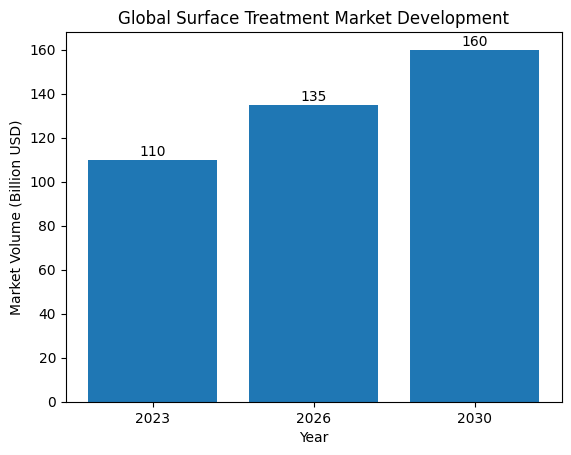
Figure 1: Development of the global surface treatment market
(Source: MarketsandMarkets 2024 Report, ZVO Industry Figures 2023)

Figure 2: Growth drivers by sector
Key projects and industrial players
Automotive & Mobility Industry
Volkswagen AG is increasingly relying on plasma-nitrided transmission components in electric drives to increase efficiency.
BMW Group uses DLC coatings in high-pressure injection systems.
Tesla, Inc. relies on highly corrosion-resistant aluminum surfaces for battery housings.
Fuel Cells & Hydrogen
Bosch is developing coated bipolar plates for fuel cells to reduce contact resistance.
thyssenkrupp nucera uses special coatings to increase the service life of electrolysis cells.
Robotics & High-Tech
KUKA AG integrates wear-resistant coatings in joint modules for longer maintenance intervals.
ABB Ltd. is focusing on corrosion-resistant surfaces in collaborative robots for the food industry.
Innovative companies in surface technology
Oerlikon Balzers – PVD/DLC Marktführer
Bodycote – Thermochemical processes
Ionbond – Thin-film solutions
Hauzer Techno Coating – PVD-Anlagen
Plasmatreat GmbH – Atmospheric Pressure Plasma
Technological innovations
1. Functional Multilayer DLC
Improves adhesion, friction and temperature resistance.
2. Plasma activation at room temperature
Allows coating of temperature-sensitive materials.
3. Nanostructured layers
Targeted control of wettability (lotus effect).
4. Smart Coatings
Self-healing coatings, sensory coatings for condition monitoring.
Scientifically documented in papers of the Max Planck Institute for Iron Research and in Progress in Materials Science, among others.
Surface technology is not a cost factor – it is a performance multiplier
In many OEM organizations, surface technology is still assigned to purchasing or production – not to development. This is strategically wrong.
Friction reduction of a few percentage points is decisive for the range of electric drives. Corrosion resistance determines warranty and recall costs.
If you only optimize "costs per square meter" instead of looking at system performance, you will lose touch technologically.
Voices from the industry
"The service life of our components is largely determined by tribological optimization." – Statement from technical white papers from Oerlikon Balzers.
In several publications, the Fraunhofer-Gesellschaft emphasizes that surfaces in e-mobility applications enable efficiency increases in the low single-digit percentage range – which is systemically significant.
Outlook
With increasing electrification, higher power densities and new material combinations, the importance of functionalized surfaces is growing exponentially.
The next evolutionary stage is integrated multifunctional layers that combine mechanical, electrical and sensory properties.
The mobility industry is faced with a decision:
Will surface technology continue to be regarded as a necessary production step – or as a strategic innovation lever?
Call to Action
How do you see that?
Is surface technology already strategically anchored in your organization – or is it still a "finishing topic"?
I look forward to your well-founded perspectives and experience in development, purchasing and production.



Comments